Drywood termites require a completely different management strategy than subterranean species because they extract moisture directly from the timber they inhabit rather than returning to Hillsborough County soil. In…
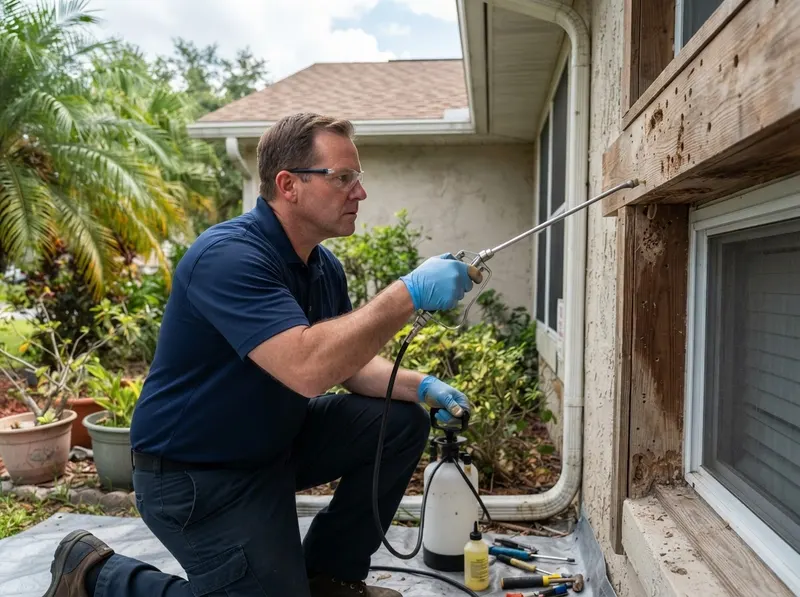
Drywood termites require a completely different management strategy than subterranean species because they extract moisture directly from the timber they inhabit rather than returning to Hillsborough County soil. In historic 1920s bungalows throughout Seminole Heights, Tampa Heights, and Hyde Park, heart pine framing and exposed rafter tails frequently face isolated colonizations following spring and summer twilight swarm flights. Unlike subterranean termites that require continuous soil barriers, drywood infestations remain contained entirely inside the wood member. Homeowners commonly discover hexagonal fecal pellets (frass) pushed out of tiny 1-millimeter kick-out holes onto baseboards or hardwood floors.
Targeted localized injection fits isolated, accessible colonies detected early in window casings, door headers, or specific attic trusses in newer builds across Westchase and New Tampa. Technicians drill tiny 1/8-inch access holes directly into active gallery chambers, injecting non-repellent termiticide foams that transfer across the colony during grooming. This clinical approach avoids family displacement and keeps treatment strictly confined to affected timbers. If multiple mature colonies perforate inaccessible roof decking or structural framing behind plaster walls across multi-story homes in Davis Islands or Palma Ceia, whole-structure fumigation or structural heat intervention becomes the necessary alternative. The trade-off centers on disruption versus access: localized treatments preserve home occupancy and lower upfront investment, but they require accessible termite galleries to guarantee absolute colony eradication.
Protecting structural integrity requires a measured, step-by-step remediation protocol. 1. Technicians complete a dark-space attic inspection using high-output illumination and acoustic sounding along roof purlins, soffits, and joists near high-humidity zones like Tampa Riverwalk and Channel District properties. 2. Active gallery depth and perimeter spread are measured and cataloged to determine if localized spot defense remains viable under Florida pest regulatory standards. 3. Technicians drill precision delivery ports into documented chambers and inject specialized transfer actives directly to the colony core. 4. Exposed structural framing receives surface-applied borate mineral salt barriers to prevent future reproductive alates from penetrating sound lumber. 5. Injection ports are patched and sealed flush with matching wood filler, followed by a total vacuum cleanup of all existing frass deposits to establish a clean monitoring baseline.
Every job gets a firm, written price after a free on-site visit.
Tell us about your drywood termite treatment job in Tampa and we'll send a clear, written quote, usually the same day.
 Gulf Finch Pest Control