Tampa's subtropical humidity, shallow water tables, and frequent summer afternoon downpours create breeding nurseries across Hillsborough County. In low-elevation river basins like Seminole Heights and Tampa Heights,…
Tampa's subtropical humidity, shallow water tables, and frequent summer afternoon downpours create breeding nurseries across Hillsborough County. In low-elevation river basins like Seminole Heights and Tampa Heights, moisture settles under dense shade canopies of live oaks, palms, and decorative broadleaf plants. Mosquito reduction treatment focuses on interrupting the complete insect life cycle rather than spraying open air. Technicians apply micro-encapsulated residual barriers directly to resting zones, specifically the undersides of leaves, groundcover shrubs, and fence perimeters, while treating non-drainable catchments with biological larvicides containing Bacillus thuringiensis israelensis (BTI). The biological larvicide affects only mosquito and blackfly larvae, preventing aquatic pupation without harming beneficial pollinators or birds.
Selecting the right treatment interval depends directly on canopy density, rainfall volume, and drainage patterns. For canal-front homes in Davis Islands or properties bordering Old Tampa Bay in Ballast Point, monthly applications from April through November offer continuous population control against high-tide salt marsh species. In urban lots like Ybor City or the Channel District, where yard boundaries are compact and wind exposure is sheltered, a targeted single-event barrier applied 48 hours prior to an outdoor gathering is an effective solution. The trade-off is longevity versus ongoing control: single applications suppress active adults for approximately 21 to 30 days, whereas recurring 28-day treatments disrupt consecutive reproductive cycles across an entire summer.
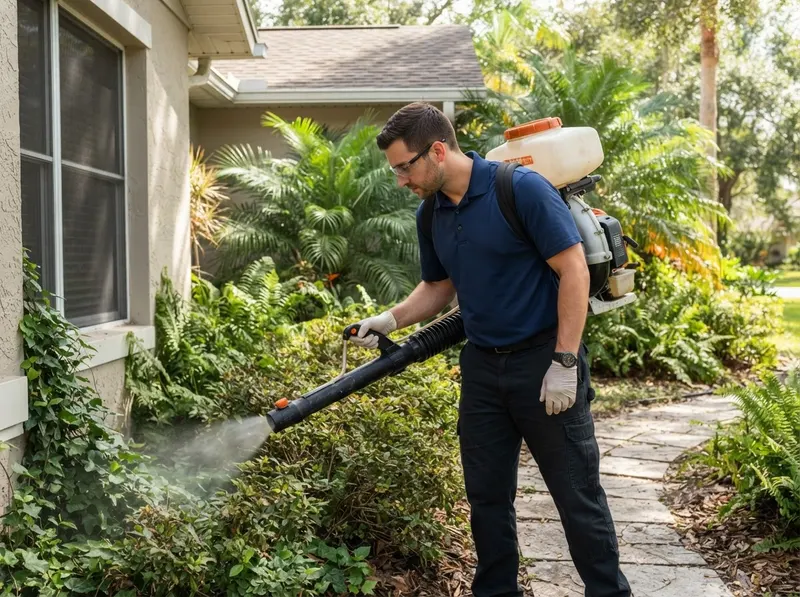
Step 1 involves an on-site perimeter walk to map stagnant moisture pockets, irrigation runoff, and dense resting canopies. Step 2 requires eliminating unmanaged standing water in saucers, tires, and gutters, followed by larvicide tablet drops into French drains and retention troughs. Step 3 utilizes a gas-powered backpack mister to deposit droplets ranging between 50 and 100 microns onto dense vegetation up to a height of 10 feet. Properties in New Tampa, Palma Ceia, and Westchase with automated drip irrigation require dry foliage conditions for 30 minutes following application to allow the residual barrier to bond firmly to leaf cuticles.
Every job gets a firm, written price after a free on-site visit.
Tell us about your mosquito reduction treatment job in Tampa and we'll send a clear, written quote, usually the same day.
 Gulf Finch Pest Control